
Buying an inflatable kayak is one of the easiest ways to get into paddling, and one of the easiest to get wrong if you don’t know what to look for. The right one packs into a bag, fits in the boot of almost any car, and has you on the water within minutes of arriving. The wrong one is heavy, unstable, and ends up in the garage after two outings.
The difference comes down to a handful of things: what it’s made of, how much weight it carries, how well it tracks, and what actually comes in the box. Get those right and an inflatable will serve you for years. Here’s everything worth knowing before you buy.
If you’re still deciding whether a kayak is the right fit for you, you can also read our SUP vs. Kayak: Which Is Best for You? guide.
Are Inflatable Kayaks Actually Any Good?
It’s the first question most people ask, usually with a bit of scepticism. The honest answer is that a well-built inflatable is a serious piece of kit, and for most paddlers it’s the more practical choice.
Modern inflatables use tough laminated PVC that resists punctures and abrasion. They’re stable, they handle rivers and open water, and they hold their shape properly once inflated to the right pressure. What they give up in outright speed against a rigid composite kayak, they more than repay in convenience.
And convenience is the whole point. A hard kayak needs roof racks, a trailer, or a garage you’re willing to sacrifice. An inflatable lives in a cupboard and travels in a bag. The best kayak is the one you actually take out, and an inflatable removes almost every excuse not to.
What to Check Before You Buy
Six things separate a kayak you’ll love from one you’ll regret. Work through them in order.
1. Material and Construction
This is the foundation. Look for laminated PVC rather than thin single-layer vinyl. It’s the difference between a proper kayak and a pool toy.
Laminated PVC resists punctures and abrasion, which matters the moment you drag the hull over a rocky launch or brush a submerged branch. It also holds up to sun exposure, which is no small thing during South African summers.
2. Weight Capacity
Check this properly, and don’t just count heads. Weight capacity has to cover the paddlers plus everything you bring: cooler bag, dry bag, water, fishing gear, and maybe a dog if that’s the plan.
A solo kayak carrying up to 150 kg suits most single paddlers with room to spare for kit. A tandem rated to 230 kg gives two adults genuine headroom rather than sitting right at the limit. Paddling a kayak loaded to its ceiling feels sluggish and sits low in the water, so buy yourself some margin.
3. One Seat or Two?
Be realistic about how you’ll actually use it, not how you imagine you might.
- Buy a 1-seater if: you’ll mostly paddle alone, you want the lightest, most manoeuvrable option, and you value being able to launch without coordinating with anyone.
- Buy a 2-seater if: you’ll paddle with a partner, friend or child, or you want the flexibility to take someone along. A tandem can often be paddled solo, but a solo kayak can never be paddled tandem.
That last point is worth sitting with. If you’re genuinely torn, the 2-seater is the safer purchase.
4. Tracking and Skegs
Tracking is how straight your kayak runs. Without a skeg, an inflatable tends to wander, and you’ll spend energy correcting instead of covering ground.
Detachable skegs give you the best of both. Fit them for open water and long straight paddles. Remove them for shallow rivers where they’d catch on the bottom.
5. Seats and Footrests
Comfort is what decides whether you paddle for an hour or for a full morning. It’s the spec people ignore and then regret.
Look for adjustable seating with proper back support, and an adjustable footrest. Bracing against a footrest is what lets you drive with your legs and core instead of hauling with your arms alone. Without it, your back does all the work and you’ll feel it the next day.
6. What’s Actually in the Kit?
This is where the real price of a kayak hides. A cheap hull with nothing else quickly becomes an expensive setup once you’ve bought a paddle, a pump and a bag separately.
A complete kit should include the kayak, a carry bag, paddles, a pump and a repair kit. Check for all five before you compare prices, because a bare kayak and a full kit are not the same purchase.
The Stormfox Avalanche Range
Stormfox sells both Avalanche kayaks as complete kits, so everything you need arrives in one bag. You can also browse the full Kayaks & Canoes range online.
Avalanche 1-Seater Inflatable Kayak Kit
The Avalanche 1-Seater Inflatable Kayak Kit is built for solo paddlers. Laminated PVC construction, a weight capacity of up to 150 kg, and ergonomic seating with adjustable back support make it a practical choice for longer days on the water.
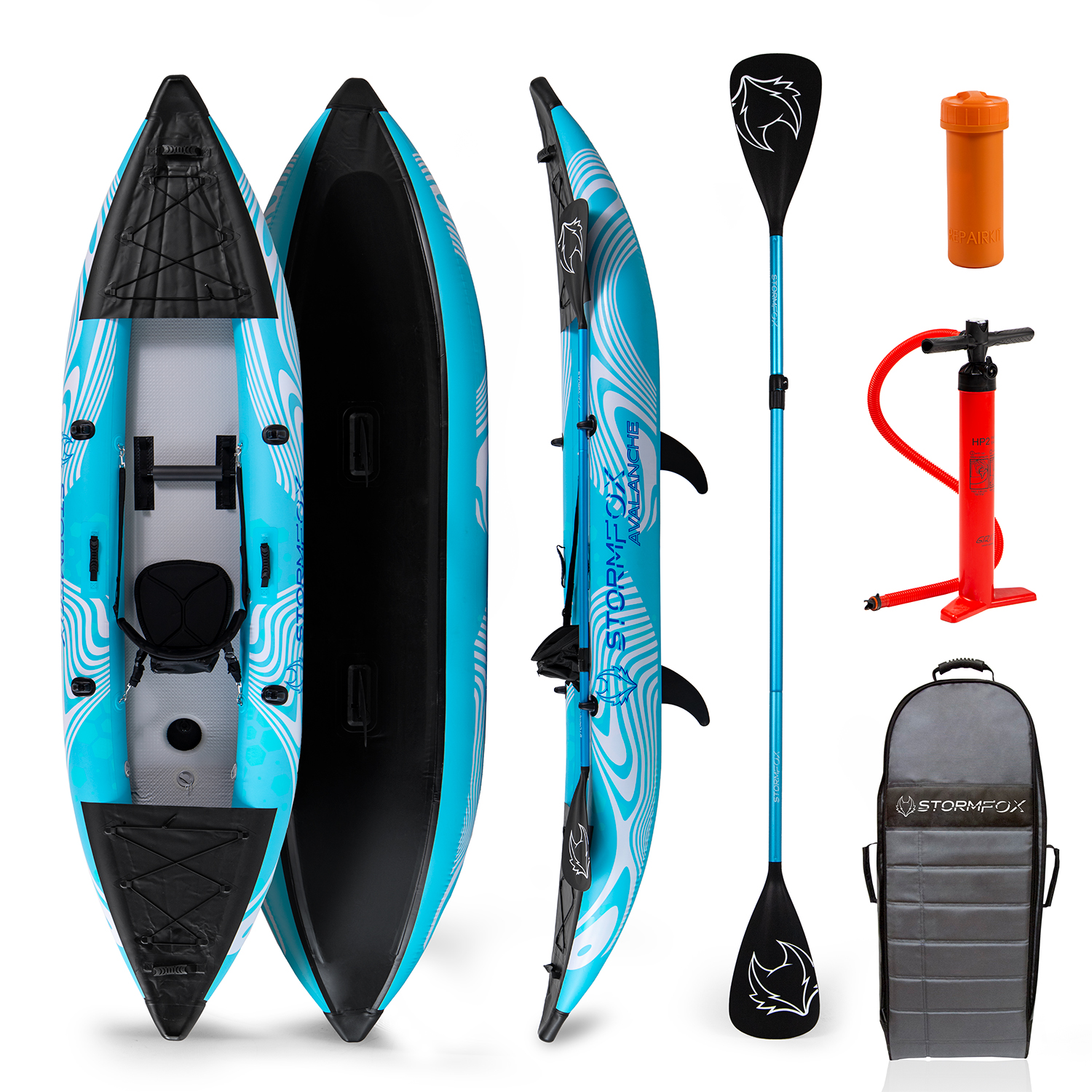
At 333 cm long and 90 cm wide, it’s stable enough for beginners while staying nimble on rivers and lakes. The kit includes the kayak, kayak bag, one alloy shaft paddle, a manual pump and a repair kit.
Shop the Avalanche 1-Seater Inflatable Kayak Kit.
Avalanche 2-Seater Inflatable Kayak Kit
The Avalanche 2-Seater Inflatable Kayak Kit is the tandem, and it’s the more feature-rich of the pair. It carries up to 230 kg, weighs 19.3 kg, and adds detachable main skegs, an adjustable footrest and tie-down points for securing gear.
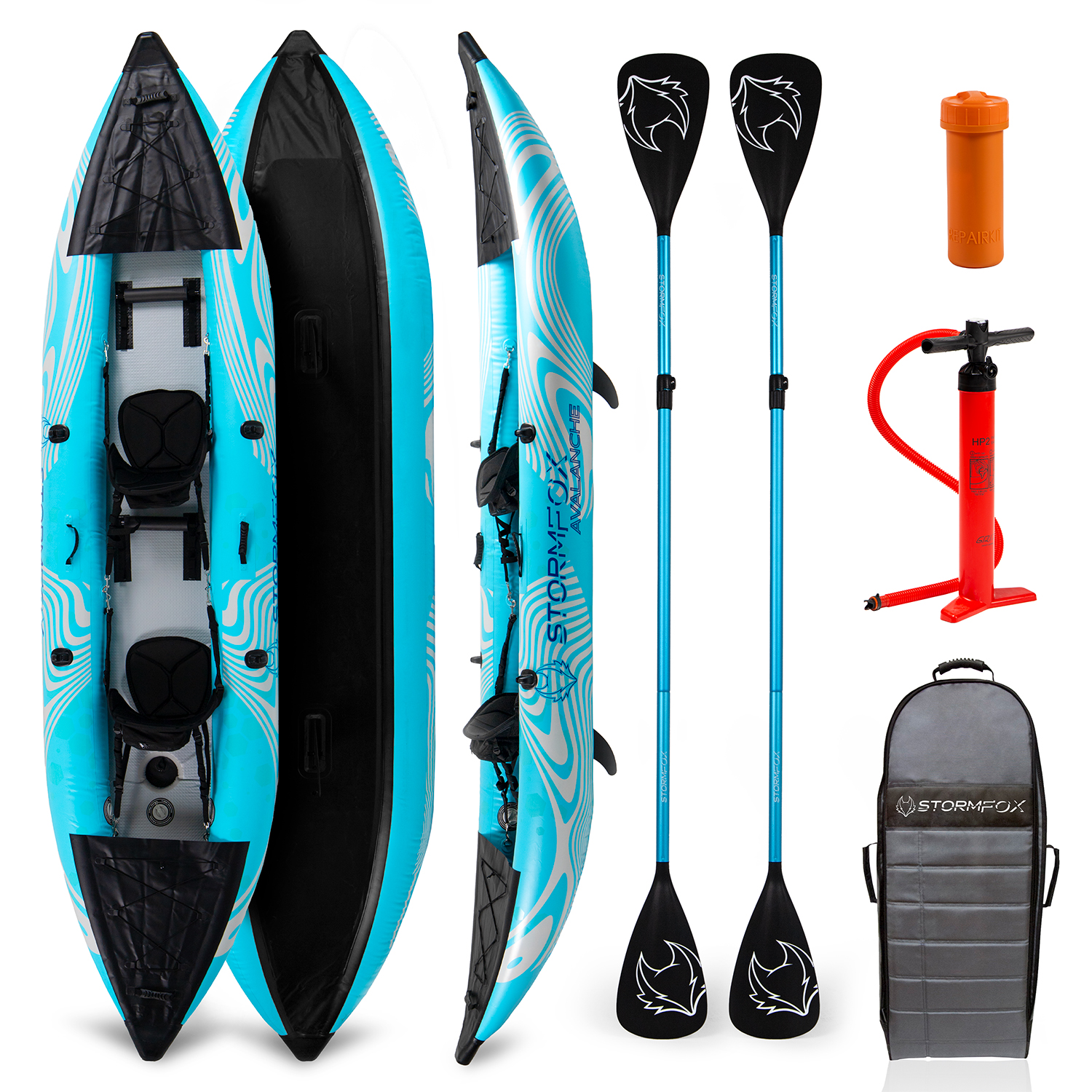
The included paddles adjust between 155 cm and 205 cm, so both paddlers can set a comfortable length. A dual-action pump moves more air per stroke, which means less time inflating and more time paddling. The kit includes the kayak, kayak bag, two alloy shaft paddles, a manual pump and a repair kit.
Shop the Avalanche 2-Seater Inflatable Kayak Kit.
Avalanche 1-Seater vs 2-Seater at a Glance
| Feature | Avalanche 1-Seater | Avalanche 2-Seater |
|---|---|---|
| Paddlers | One | Two |
| Weight capacity | Up to 150 kg | Up to 230 kg |
| Dimensions | 333 × 90 × 60 cm | 382 × 91 × 41 cm |
| Kayak weight | Lightweight solo hull | 19.3 kg |
| Paddles included | 1 alloy shaft paddle | 2 alloy shaft paddles, 155 to 205 cm |
| Skegs | Fixed setup | Detachable main skegs |
| Footrest / support | Adjustable back support | Adjustable seating and footrest |
| Best for | Solo exploring, rivers and lakes | Couples, friends, parent and child |
Both kits pack into the same carry bag, measuring 69 × 30 × 108 cm, which slides into a boot without folding a seat down.
Setting Up and Packing Down
Inflation is the part people worry about and then forget entirely after their first outing. With a dual-action pump you’re looking at a few minutes, not an ordeal.
Inflate to the recommended pressure and no less. An underinflated kayak feels soft, sits low and paddles badly, and most complaints about inflatables trace straight back to this. Firm is fast.
Packing down is the reverse. Deflate, rinse off salt or river water, and let it dry properly before rolling it into the bag. A kayak packed away damp will develop mildew and smell, which is the one avoidable way to shorten its life.
Where You Can Take It
This is the fun part. A laminated PVC inflatable is at home on dams, rivers, estuaries, lagoons and sheltered coastal water. Fit the skegs for open stretches, take them off for shallow rivers, and check the wind before you launch on anything exposed.
Because the whole kit fits in a bag, the kayak comes with you. Weekends away, road trips, a spontaneous afternoon at the dam. That is the real argument for an inflatable, and it’s the one that matters most.
Buying with Confidence
A few practical points worth knowing before you commit:
- Both Avalanche kits carry a 12-month warranty.
- Stormfox offers door-to-door delivery nationwide, along with secure online payments and a money-back guarantee.
- If you’d rather spread the cost, Stormfox has a payment plan option. You can open an account to see what’s available.
- Keep the repair kit with the kayak rather than at home. A small puncture is a quick fix on the bank and a ruined day without a patch.
Ready to Get on the Water?
Choosing an inflatable kayak comes down to honest answers about how you’ll paddle. Alone or with someone. Rivers or open water. How much gear you carry. Answer those and the choice narrows quickly. If you’re still torn between the Avalanche 1-Seater and the Avalanche 2-Seater, take the tandem. The extra capacity costs you very little and opens up far more paddling.
Browse the full Kayaks & Canoes range, which also includes the Cyclone canoe kits, or explore SUP Kits and Accessories to round out your setup.
Then find your nearest water and set out for an adventure.